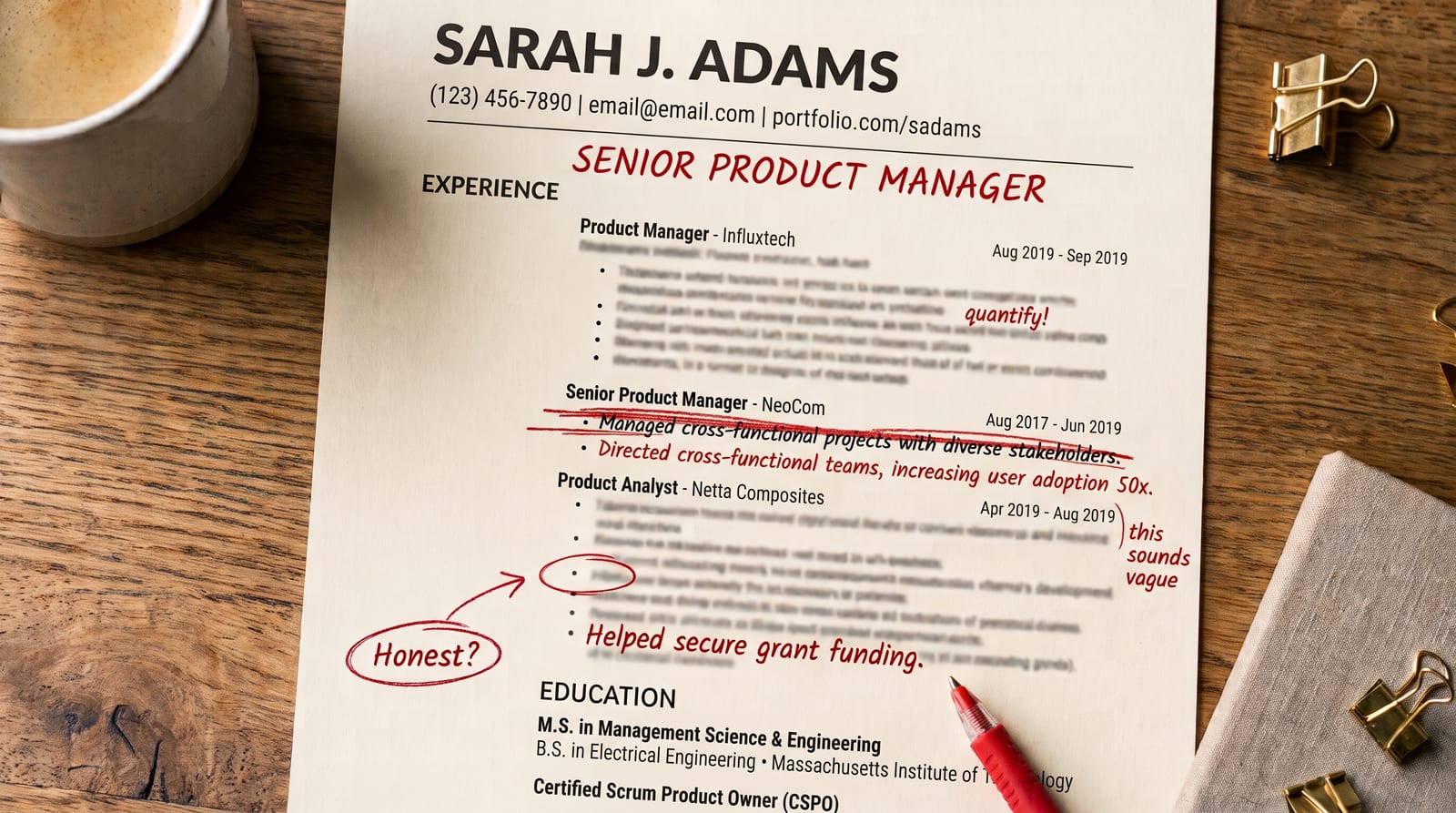
A design leader I know was applying everywhere and hearing nothing. He was sure the problem was his portfolio, so that's where all his energy went. I cut him off and said, "send me your resume." It had emojis, it was too casual, and it was way too light on actual outcomes. Another colleague and I gave him blunt feedback, he made the changes, and he started getting bites almost immediately.
The portfolio was never the problem. The resume was.
I think of the resume as the front door. A lot of people treat their portfolio or their side projects as the front door, the thing that gets them in the building. It's not. The resume is what catches a stranger's eye and earns you the conversation. The portfolio is what wows them once you're through it. Get that order backwards and nobody ever sees your best work, because they never let you in.
It's almost always the resume
When someone tells me their search has stalled, it's almost always the resume. Not the ATS. Not an AI gatekeeper automatically trashing your file. Not ghost jobs or the economy, though the market is really brutal right now. The resume is the first thing I check, and it's usually where the problem lies.
"The system is rigged against me" is a more comforting story than "my resume isn't landing." But only one of those is something you can fix this weekend.
And the scoreboard that matters is simple: count the interviews your resume has generated, not the applications you've sent. If you've fired off eighty applications and gotten two screens, applying harder just scales the broken step.
You don't need a custom resume for every job
The standard advice is to tailor your resume to every posting. I don't, and I tell people not to.
It's partly the time, since customizing per application is a slog and it's error-prone. But the bigger issue is that recruiters can smell when they're being gamed. A resume keyword-stuffed to mirror one specific posting reads as exactly that, and it works against you with the people who matter most. On top of that, in this market roles often expire before you even clear the queue. Things move too fast to hand-craft a custom resume for each job you apply to.
So put your energy into one strong, honest resume, maybe a second version if you genuinely straddle two kinds of roles. Then calibrate it like this: pull up three to five of your actual dream job descriptions and check whether one resume can speak to all of them. Not word for word, just generally. Does it cover what those roles are really asking for?
If it can't, one of two things is true. Either the resume isn't sharp enough yet, or the jobs you picked aren't realistic targets. Both are worth knowing now.
Your next move: one competitive resume that leads with impact and covers your real targets, instead of fifty tailored ones that trip a recruiter's "too targeted" radar.
So I took my own advice
I say this to people constantly, so I owed it to myself to actually do it. I just overhauled my own resume. The bones were already solid, so the work was mostly in the story it told, and I worked through the changes with a recruiter I know, someone who sees what actually makes a hiring manager say yes. (That kind of relationship is worth building long before you need it.)
The biggest change was the goal itself. I stopped trying to look impressive and started trying to look like a safe hire who can hit the ground running. Steady, low-ego, the collaborative glue a team actually wants. Once that was the target, every edit got easy. Here's what changed:
- I led every bullet with impact, and cut the filler that buried it. "Led cross-functional teams around a roadmap" says nothing. I deleted the glue-work lines so the real numbers had room to land: 50x conversion, 11.5 million users, bulk uploads from days to minutes. Outcome first, mechanics second.
- I put my longest tenure back on the page. I'd cut my earliest jobs to keep the resume to two pages and feel recent. But once I trimmed the filler, the space opened back up, so I put them back. One was my first job out of school as an engineer, the other a six-year run as a consultant. Those two entries probably do a lot more for my credibility than anything I dropped to make room. The six-year consultant run is genuine long tenure, and together they anchor the engineer-who-became-a-PM story and subtly put stability back on the page. Keeping things recent was costing me more than it saved.
- I made the recent moves read as deliberate, not drift. Two short stints back-to-back can look like restlessness. So I made the logic explicit for each one: why I joined, what I shipped, why I left. Same timeline, completely different read.
- I chose findable over clever. I like "Full Stack Product Manager" as a personal brand, but recruiters search "Senior Product Manager." I'd rather be found than clever, so I changed the headline and rewrote my summary to lead with how I actually work: an engineer who became a PM and builds zero to one.
- I made it honest enough to survive an interview. I'd written that I "sourced" a grant. The truer version is that I "helped secure" it, so that's what it says now. Anything on your resume you can't defend calmly in the room will work against you, not for you.
- I told one story everywhere. My resume, my LinkedIn, and my website now line up, so a recruiter who cross-checks meets one consistent person instead of three different drafts. It's the same reason I keep an eye on what AI says about me when someone looks me up.
I was afraid to cut.
I didn't want to lose those lines. It felt like erasing work I was proud of. But all that detail was jumbling the message, not adding to it. The throughline of every change: less "look how much I've done," more "here's exactly what you get." I expected that to feel like shrinking. It did the opposite. Naming exactly what you bring is a more confident position than piling on everything you've ever touched.
So if your applications aren't turning into interviews, the most fixable problem you have is sitting in a document right now. Pick the one thing you want a stranger to walk away believing about you, and rebuild around it.
When's the last time someone you trust gave your resume honest, brutal feedback?