I check my inbox twice a day. That's enough.
Once at 8am, once at 6pm. It's the closest thing to a real digital detox I've done, and I'm doing it in the middle of the most competitive job market I've ever seen.
A lighter, open-source version of this assistant is available as a Claude Code plugin you can install yourself.
I see this every week in office hours: people come in already at a higher state of stress than most. The competitive market is one thing. The 24/7 notification and inbox roulette on top of it is what wears people down. Anything I can do intentionally to dial that down is worth doing.
For previous job searches, email, calendar, and LinkedIn ran my entire day. A reply would land and I'd context-switch. A rejection would land and I'd go to update my tracker and thank the recruiter. What I felt all day was whatever the inbox decided to send me, in the order it arrived.
This time around, I built an AI assistant that handles the heavier parts of the process. It runs on a Mac Mini in my office, has its own email address and iMessage account, and texts me twice a day. It sends me a morning briefing, new job leads, a rejection summary, and my HomePod also reads it aloud while I start my day.
The assistant is one-way: it texts me, I don't text it. A chat interface is on the table eventually, but the whole point right now is to interact with technology less, not more.
What 8am looks like
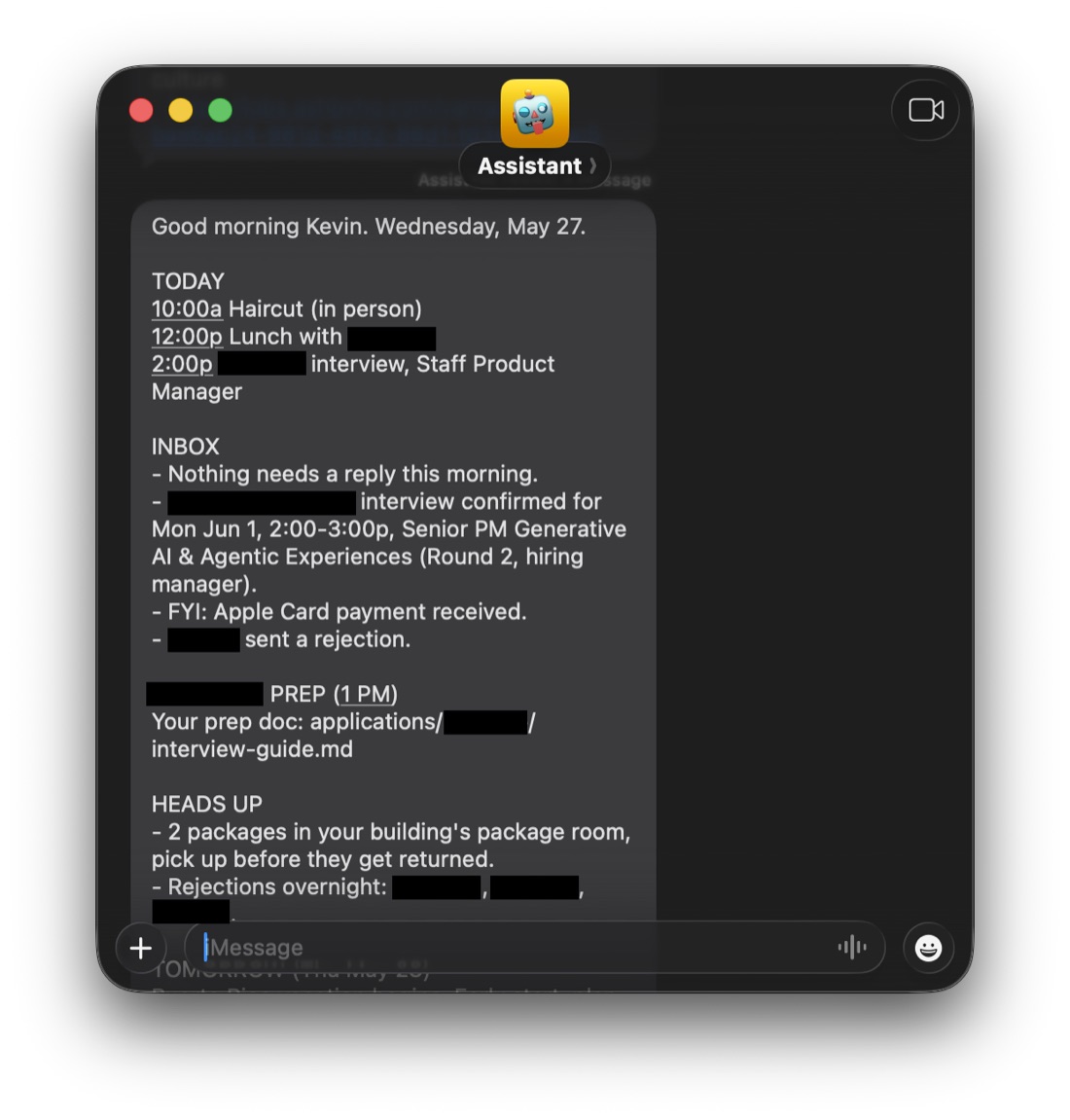
The 8am text breaks the day down. Today: A haircut, lunch with a friend, interview at 2pm. Inbox: nothing that needs a reply right now, but a round two is confirmed for Monday and one company sent a rejection. Prep: a link to my interview-guide doc to review at 1pm before the interview. And at the bottom, the heads-up: a couple of packages to grab, and three rejections that came in overnight.
Before this, I would have absorbed those across the day as three separate cortisol hits the moment each email landed. With this, I read them once in context. Same information, a single cortisol hit.
What my job scan report looks like
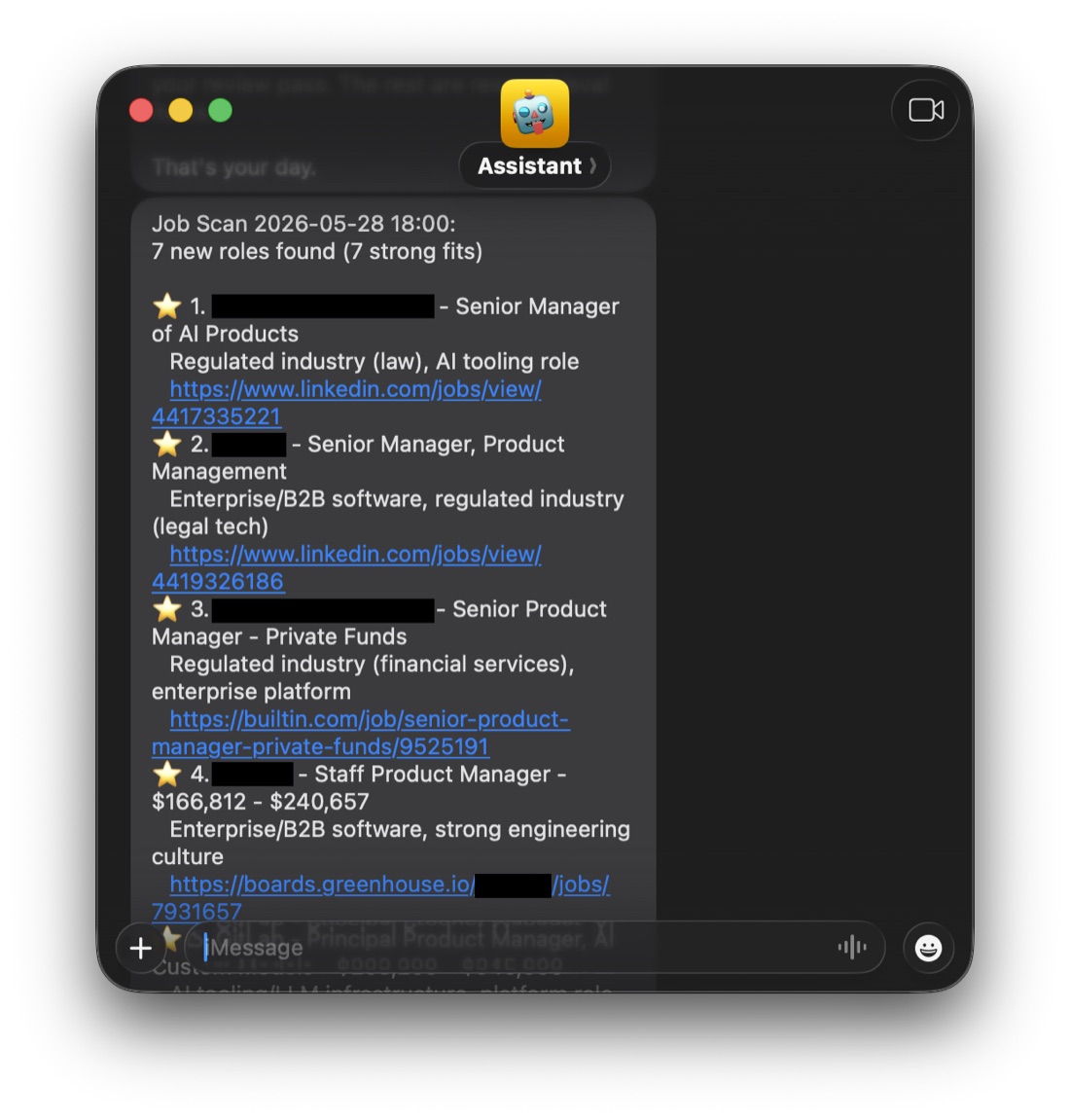
The next text is the morning job scan (which also repeats at 6pm). A handful of new roles, surfaced from the boards, filtered for what I'm actually targeting, with a one-line note on why each one fits. Instead of opening LinkedIn and scrolling past hundreds of listings, I open the few that already match and apply to those midmorning.
What I get out of it
Two things:
Doing projects like this keeps me sharp. Building a real product, even one with an audience of one, is the closest thing to PM work when I'm between roles. I'm shipping, debugging, deciding what's in scope, making it useful enough that I actually use it. This is what is keeping me ready for the next interview when I get asked, “What have you built with AI?"
Then there's the calm. I get to choose when to engage instead of being summoned. I get to be present with friends and family, in interviews, in office hours, in my actual life outside of my inbox. The job search is still hard, it just isn't consuming all of my attention.
24/7 isn't a job search strategy
There's a version of job searching, and of modern work in general, that runs on the assumption that you have to be available all the time to be trying hard. Refresh the inbox, check your notifications, watch those connection requests, and ride every dopamine spike and cortisol drop in real time, so you can prove you're in the fight.
I think the constant refreshing and checking is the thing that wears most people down, leaving them less energized for interviews, meetings, and follow-ups.
That's how I landed on twice a day (8am, 6pm). Everything else, the assistant handles. I get to spend the rest of my time on what I actually want to be doing.
The goal is to touch technology less
Here's the part that feels backwards for someone who loves this stuff: I'm building all of this so I can interact with technology less, not more. The dream is a quick conversation with my assistant, the thing gets done, and I go live my life.
I'm not all the way there. Some days, building the system is its own time sink. But the search already feels less like roulette and more like something I have a handle on, and that alone has been worth it.
The point isn't the system. I show up better when I'm not bracing for the next notification. For my family, my friends, the interviews I'm in, and the work I actually want to be doing.
If you're in the thick of a search and it's wearing you down, you don't have to build all of this.
But you might be surprised how much lighter it feels to hand even one tedious piece to a system and never touch it again
If you want a smaller starting point, the open-source version of this assistant is a Claude Code plugin you can install yourself.